Samarkand, a city that echoes with the footsteps of centuries, stands as a jewel in the heart of Uzbekistan, a testament to the grandeur of Central Asian civilization. Nestled along the Silk Road, Samarkand’s rich history, breathtaking architecture, and cultural significance have earned it a place among the world’s most captivating destinations. This essay aims to unravel the geographical, historical, and cultural dimensions of Samarkand, shedding light on the city’s enduring legacy.
Geographical Setting: Samarkand is located in the northeastern part of Uzbekistan, in the fertile valley of the Zeravshan River. Surrounded by the Zarafshan Range and flanked by the Pamir-Alay mountain range to the south, the city benefits from a strategic location that has made it a natural center for trade and cultural exchange.
Ancient History: The history of Samarkand is ancient, with archaeological evidence suggesting human habitation in the area as early as the 7th century BCE. The city has been a melting pot of cultures, witnessing the rise and fall of various empires, including the Persian Empire and the conquests of Alexander the Great.
Silk Road Hub: Samarkand rose to prominence as a vital hub along the Silk Road, the ancient trade route that connected East and West. The city became a center for commerce, bringing together merchants, scholars, and travelers from different corners of the world. Samarkand’s bazaars and caravanserais buzzed with activity, showcasing the wealth of goods and ideas flowing through the city.
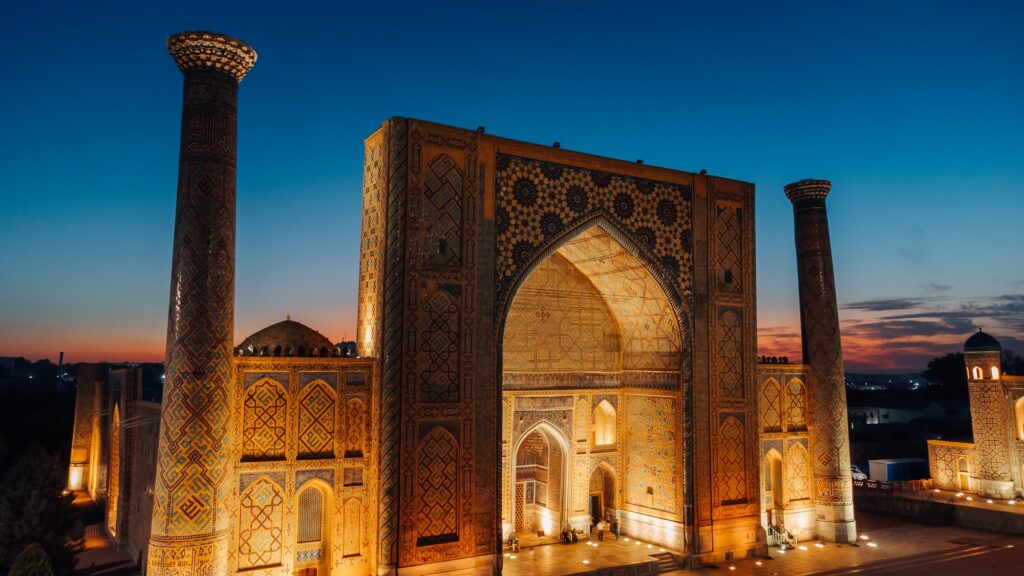
Islamic Golden Age: With the advent of Islam in the 8th century, Samarkand became a beacon of Islamic culture and learning. The city’s scholars made significant contributions to various fields, including astronomy, mathematics, and medicine. Samarkand’s Registan Square, a UNESCO World Heritage Site, became a center of intellectual pursuits, surrounded by madrasas and mosques that reflected the architectural splendor of the Islamic Golden Age.
Timurid Renaissance: The 14th and 15th centuries marked a golden era for Samarkand under the rule of Timur (Tamerlane) and the Timurid dynasty. The city experienced a renaissance in art, architecture, and culture. Timur’s capital, Samarkand, became a showcase of grandiose structures such as the Bibi-Khanym Mosque, the Ulugh Beg Observatory, and the Gur-e Amir mausoleum, where Timur himself is buried.
Babur and the Mughal Connection: Samarkand holds a special place in the history of the Indian subcontinent as the birthplace of Babur, the founder of the Mughal Empire. Babur’s connection to Samarkand is immortalized in his memoirs, the “Baburnama,” where he recounts the city’s beauty and significance. The Mughal rulers, descendants of Babur, drew inspiration from Samarkand’s cultural legacy in shaping their own empire.
Russian Conquest and Soviet Era: In the late 19th century, Samarkand came under Russian influence and later became part of the Soviet Union. The city underwent changes in governance, urban planning, and societal structures. However, efforts were made to preserve Samarkand’s historical monuments, and the city retained its allure as a cultural and architectural treasure.
Independence and Cultural Preservation: With the independence of Uzbekistan in 1991, Samarkand entered a new chapter in its history. The government, along with international organizations, has been dedicated to preserving and restoring the city’s cultural heritage. Conservation projects have focused on maintaining the authenticity of Samarkand’s historical sites while promoting sustainable tourism.
Architectural Marvels: Samarkand is renowned for its architectural marvels, characterized by intricate tilework, majestic domes, and soaring minarets. The Registan Square, flanked by the Ulugh Beg Madrasa, the Sher-Dor Madrasa, and the Tilya-Kori Madrasa, is a masterpiece of Islamic architecture. The Shah-i-Zinda necropolis, with its dazzling array of mausoleums, stands as a testament to the city’s artistic achievements.
Cultural Traditions: Samarkand’s cultural traditions are deeply rooted in its history and the convergence of diverse influences. Traditional music, dance, and craftsmanship are celebrated in cultural events and festivals, providing a window into the city’s vibrant heritage. The centuries-old Silk Road traditions continue to thrive in Samarkand’s vibrant bazaars.
Contemporary Samarkand: In the contemporary era, Samarkand remains a living testament to the enduring spirit of Central Asian civilization. The city has embraced modernity while preserving its historical identity. Tourism has flourished, drawing visitors from around the world to experience the magic of Samarkand’s monuments and immerse themselves in its rich cultural tapestry.
Conclusion: In conclusion, Samarkand stands as a living chronicle of human history, a city where the echoes of the past resonate through its streets and monuments. From its role as a Silk Road crossroads to the heights of the Timurid Renaissance, Samarkand has left an indelible mark on the cultural landscape of Central Asia. As the city continues to enchant visitors with its architectural splendor and cultural richness, Samarkand remains an enduring symbol of the enduring legacy of human civilization.