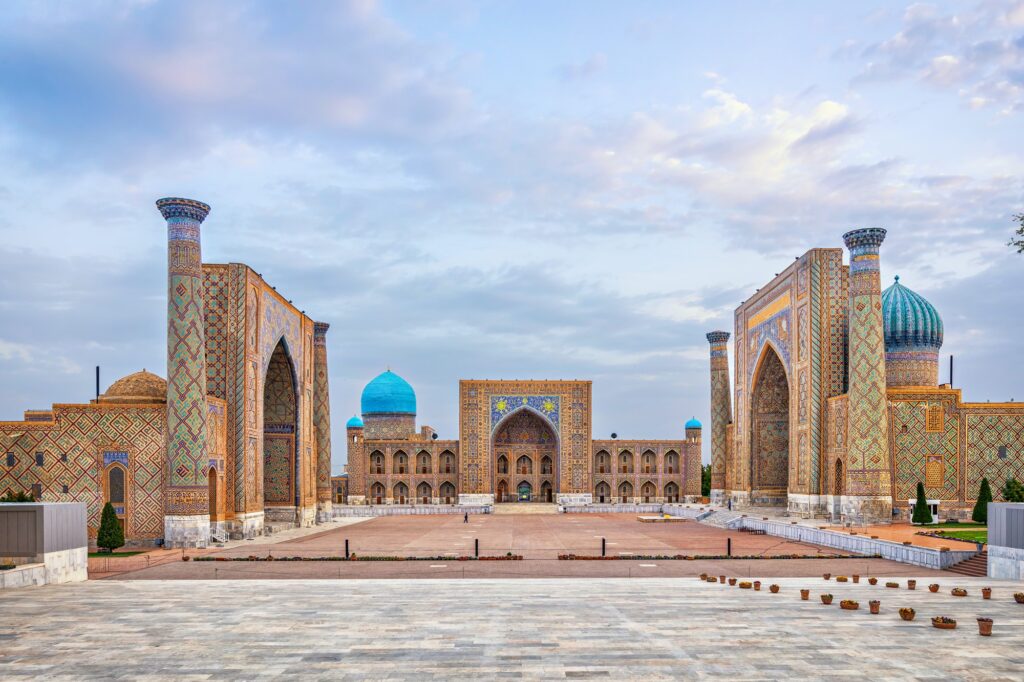
Registan, the heart of Samarkand, Uzbekistan, is a dazzling ensemble of majestic madrasahs that stand as enduring symbols of the city’s rich history, architectural prowess, and cultural significance. Surrounded by bustling bazaars and the echoes of Silk Road tales, Registan Square has been a center of commerce, scholarship, and artistic achievement for centuries. This essay aims to explore the geographical, historical, architectural, and cultural dimensions of Registan, unveiling the allure that has captivated travelers and scholars alike.
Geographical Setting: Registan Square is situated at the heart of Samarkand, one of the oldest inhabited cities in Central Asia. Samarkand lies in the Zerafshan River valley, framed by the Zarafshan mountain range to the north and the Turkestan mountain range to the south. Its strategic location along the Silk Road has contributed to its historical prominence.
Historical Significance: The history of Registan is intertwined with the history of Samarkand itself, dating back over two millennia. As a major stop on the Silk Road, Samarkand became a melting pot of cultures, attracting merchants, scholars, and artisans from diverse corners of the ancient world. Registan Square, initially a bustling commercial center, evolved into an architectural and intellectual hub.
Silk Road Legacy: Registan Square played a pivotal role in the Silk Road’s narrative, serving as a vibrant marketplace where goods, ideas, and cultures converged. The square’s history reflects the interweaving of diverse influences, from Persian and Islamic to Central Asian and beyond. Traders, poets, and scholars traversed Registan, leaving an indelible mark on its cultural tapestry.
Architectural Marvels: The centerpiece of Registan Square is its trio of grand madrasahs: Ulugh Beg Madrasah, Sher-Dor Madrasah, and Tilya-Kori Madrasah. Each madrasah is a testament to the architectural brilliance of its era. Ulugh Beg Madrasah, built in the 15th century by the Timurid ruler Ulugh Beg, is known for its astronomical observatory. Sher-Dor and Tilya-Kori, constructed in the 17th century, showcase intricate tilework and delicate ornamentation.
Ulugh Beg Madrasah: Ulugh Beg Madrasah, the oldest of the three, stands as a tribute to the Timurid Renaissance. Its entrance portal, adorned with azure tiles and geometric patterns, leads to a courtyard where students once gathered for scholarly pursuits. The madrasah’s standout feature is the remains of an astronomical observatory, underscoring Ulugh Beg’s contributions to astronomy during the Islamic Golden Age.
Sher-Dor Madrasah: Sher-Dor, meaning “Lion-Bearing,” is characterized by its twin minarets and a central iwan adorned with mosaic tiles. The minarets, adorned with roaring lion motifs, are unique in Islamic architecture. The intricate tilework depicts various scenes, including galloping riders and roaring lions, adding a dynamic and vibrant touch to the facade.
Tilya-Kori Madrasah: Tilya-Kori, meaning “Gilded,” is the newest of the three madrasahs and stands opposite Ulugh Beg Madrasah. Its exterior is adorned with stunning tilework, but the true gem lies within its prayer hall. The intricate gilded decorations on the mosque’s interior walls lend it an ethereal quality, creating a space of spiritual and artistic beauty.
Cultural Intersection: Registan Square serves as a crossroads of cultures, where Islamic and Central Asian architectural styles meld seamlessly. The intricate tilework, geometric patterns, and calligraphic inscriptions reflect the artistic achievements of the Islamic world. At the same time, the layout and design of the madrasahs pay homage to Central Asian architectural traditions.
Role in Education: Historically, the madrasahs of Registan were not only centers of artistic and architectural achievement but also institutions of learning. Students from across the region came to Samarkand to study theology, philosophy, mathematics, and astronomy under the tutelage of renowned scholars. The intellectual legacy of Registan echoes in the corridors of its ancient madrasahs.
Cultural Revival: In the modern era, Registan Square has experienced a cultural revival. The restoration and preservation efforts undertaken by UNESCO and local authorities have ensured that the splendor of Registan endures for future generations. The square has become a symbol of Uzbekistan’s cultural identity, drawing visitors from around the world to marvel at its architectural wonders.
Tourist Attraction: Registan Square is a major tourist attraction, welcoming visitors with its grandeur and historical significance. The square comes alive with cultural events, light displays, and festivals, creating a vibrant atmosphere. The adjacent bazaars, once buzzing with traders, continue to offer a glimpse into the region’s vibrant market traditions.
Cultural Festivals: Registan Square serves as a venue for cultural festivals and events that celebrate Uzbekistan’s rich heritage. Music, dance, and traditional performances unfold against the backdrop of the illuminated madrasahs, creating a captivating fusion of past and present.
Conclusion: In conclusion, Registan Square stands as a jewel in the crown of Samarkand, an embodiment of the city’s historical legacy and architectural brilliance. Its madrasahs, with their intricate tilework and timeless elegance, tell the story of a bygone era when Samarkand thrived as a center of commerce, culture, and intellectual pursuits. As Registan continues to captivate the imaginations of visitors, it remains a testament to the enduring allure of Central Asia’s Silk Road legacy.