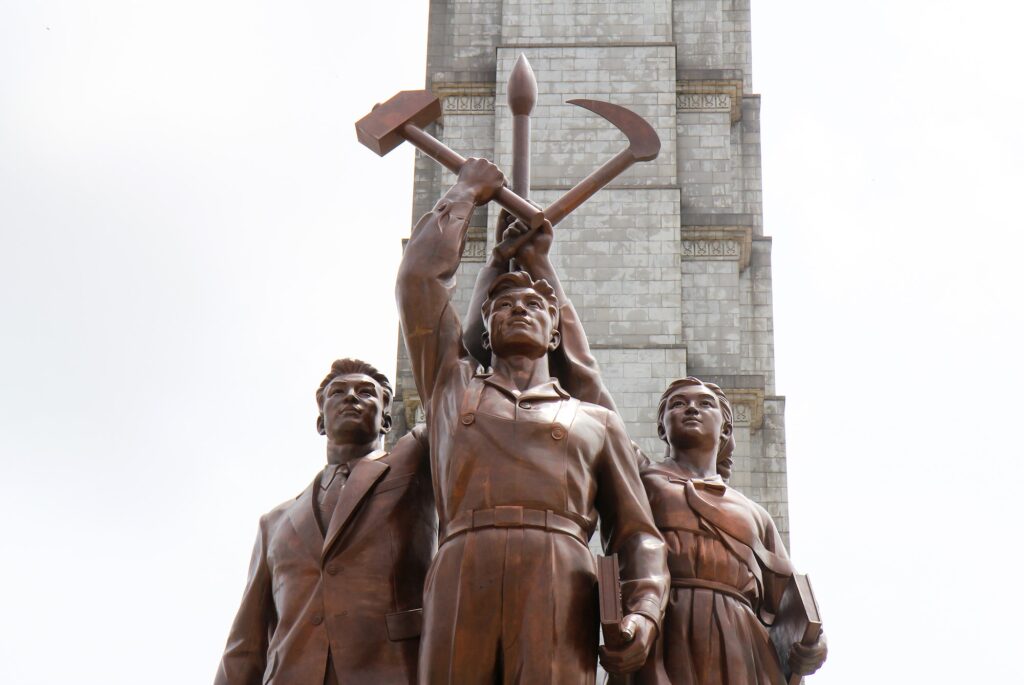
Symbolizing North Korean Ideology and Architectural Grandeur
Standing proudly on the banks of the Taedong River in Pyongyang, North Korea, the Juche Tower is a towering monument that encapsulates the essence of the country’s political ideology and architectural prowess. Erected to honor the Juche philosophy, a guiding principle developed by Kim Il-sung, the founding leader of the Democratic People’s Republic of Korea (DPRK), this monument is a prominent symbol of North Korean self-reliance, independence, and the cult of personality surrounding its leaders.
The Juche Tower, officially named the Tower of the Juche Idea, was inaugurated on April 15, 1982, to mark the 70th birthday of Kim Il-sung. Rising to a height of 170 meters (560 feet), it dominates the Pyongyang skyline, making it one of the most recognizable landmarks in the city.
The primary concept behind the Juche philosophy is the idea of self-reliance and independence. Juche, often translated as “self-reliance,” emphasizes the importance of a nation relying on its own resources, both economically and ideologically, rather than being dependent on external influences. The Juche Tower serves as a tangible representation of this philosophy, with its design and symbolism carefully crafted to convey the principles of self-reliance and autonomy.
At the base of the tower, there is a large plaza adorned with sculptures and monuments that further amplify the message of Juche. The plaza features statues and reliefs depicting scenes of resilience, industry, and the collective spirit of the North Korean people. This carefully curated space serves as a prelude to the ascent up the tower, providing a visual narrative of the nation’s commitment to the Juche ideology.
The Juche Tower is composed of 25,550 white granite blocks, symbolizing the birthdate of Kim Il-sung on April 15 (25,550 in the North Korean calendar). The tower itself is topped with a flickering red flame, symbolizing the eternal presence of the Juche idea and the immortality of the country’s leaders. The flame is visible from various vantage points in Pyongyang, serving as a constant reminder of the ideological principles enshrined in the tower.
The tower is divided into multiple levels, each with its unique significance. Visitors can ascend the tower through an elevator that takes them to an observation platform, offering panoramic views of Pyongyang and its surroundings. The observation deck provides a unique perspective on the city, allowing visitors to appreciate the carefully planned urban architecture of the North Korean capital.
As one ascends the tower, the walls are adorned with inscriptions of Kim Il-sung’s speeches and writings, reinforcing the ideological foundation of Juche. The interior of the tower serves as a quasi-museum, showcasing gifts and tokens of admiration presented to Kim Il-sung by various foreign dignitaries and organizations. This collection reflects the diplomatic significance of the Juche philosophy in North Korea’s foreign relations.
While the Juche Tower is undoubtedly a symbol of political ideology, it is also a remarkable feat of architecture. The tower’s sleek and modern design, with its sharp angles and clean lines, reflects the influence of socialist realism and modernist architectural principles. The juxtaposition of the tower against the Pyongyang skyline creates a visually striking image, emphasizing the monument’s role as both a political and architectural landmark.
Despite its architectural splendor, the Juche Tower is not without controversy. Critics argue that the monument, like many others in North Korea, perpetuates a cult of personality and suppresses dissenting voices. The emphasis on the infallibility of the country’s leaders, embodied in the perpetual flame atop the tower, has been a point of contention in international discussions about North Korea.
In conclusion, the Juche Tower stands as a monumental embodiment of North Korea’s Juche ideology and architectural grandeur. From its imposing height to the carefully curated symbolism, every aspect of the tower is designed to convey the principles of self-reliance and independence. As a key landmark in Pyongyang, the Juche Tower is not only a testament to the nation’s political ideology but also a reflection of the intersection between ideology and architecture in the North Korean context.